

When we think about crisis preparedness for libraries, we often focus on emergency plans, communication protocols, and service continuity. But there’s another crucial step that can make or break your ability to respond effectively to a crisis: removing barriers to library access and use—before a crisis hits.
This just one piece a larger conversation about preparing your library to meet community needs during difficult times. (I cover it in more detail in my on-demand webinar, “Crisis Preparedness for Libraries.”) Why is it so important? Because the more accessible and customer-friendly your library is during “normal” times, the more resilient and responsive it can be during a crisis.
Let’s walk through what that looks like, using the library marketing funnel as our guide.
Understanding the Library Marketing Funnel
The marketing funnel is a universal concept—used in retail, healthcare, education, and yes, libraries—to illustrate the customer journey. In the library context, it maps how someone in your community becomes aware of the library, grows interested, evaluates its relevance, decides to use it, and—if all goes well—becomes a loyal patron and advocate.
But here’s the key: barriers at any point in that funnel can interrupt the journey. And during a crisis, those barriers become even more problematic. (See funnel image at the end of this post.)
Start at the Top: Awareness and Interest
One of the biggest early-stage barriers is simply lack of awareness. If your community doesn’t know what you offer—or doesn’t see the library as relevant—they won’t engage, and they won’t turn to you in a crisis.
Investing in robust marketing and communications helps remove this barrier. It also builds the trust and familiarity you’ll need when the next emergency hits.
Consideration and Evaluation: Are You Convenient and Relevant?
As potential users evaluate your library, they’re asking: Does this fit into my life? Is it worth my time?
If your hours, locations, or services aren’t convenient or don’t feel relevant, they’ll move on. And if, in the middle of a crisis, you suddenly have to pivot to digital services or change your operations, that existing skepticism can grow into disengagement.
Ask yourself:
- Are your services solving real problems for real people?
- Are you making it easy for them to say “yes” to the library?
Decision Point: Make Access Easy
The decision to use the library often hinges on how easy it is to get started. A classic barrier? Library card registration.
If users have to come into a branch in person, show multiple forms of ID, and jump through hoops just to get a card, that’s a problem—even more so during a public health crisis, when in-person access may not be possible.
During the COVID-19 pandemic, many libraries wisely removed those in-person requirements. But if your library reverted back, it’s time to reconsider. Access should be digital, simple, and fast. Because barriers don’t just show up during pandemics. They exist every day in the form of job schedules, transportation issues, and childcare responsibilities.
Loyalty and Advocacy: Avoid Unnecessary Friction
Let’s say a user gets a card, checks out a book, and has a good experience. What stops them from returning?
Often, it’s something small—but frustrating. Maybe their card inexplicably expires, even though they’re active users. Maybe they come in excited, only to be told they can’t use a computer or check out materials because of overdue fines.
We need to ask: What purpose do these policies serve? If they create more harm than benefit—for both patrons and staff—it’s time to let them go.
For example, in one library, the policy was to block computer and e-resource access for patrons who owed fines. Staff developed elaborate workarounds to help people log in anyway—because the people who needed the computers most were often those who couldn’t afford the fines. Eventually, the library changed the policy: fine limits only impacted physical checkouts, not digital access. The result? Happier users, less staff frustration, and more accurate usage stats.
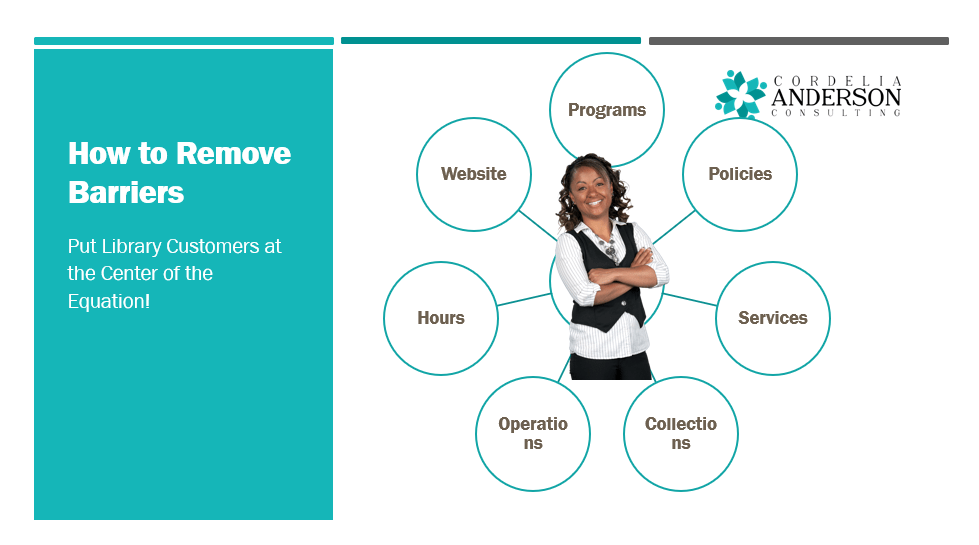
Keep the Customer at the Center
Removing barriers might feel overwhelming—there are a lot of policies, departments, and systems involved. So here’s a simple rule: put your customer at the center of every decision. (See image at the bottom.)
When you’re revisiting policies, planning services, or setting up operations, don’t just ask “what’s easier for us?” Ask “what’s easier for our users?”
Talk to your frontline staff. They know what the barriers are—and they’ve probably already come up with unofficial fixes. Make those fixes official. Eliminate the extra steps. Reduce the friction. Make your library easier to use before the next crisis arrives.
A Few Final Tips:
- Opt all patrons into email communications by default. It’s essential during a crisis—and valued even outside of one. Most libraries see less than 1% unsubscribe rates when they do this.
- Train staff regularly in customer service, so they’re prepared to offer empathy and solutions—especially under stress.
- Eliminate fines and card expirations wherever possible. They’re outdated barriers that disproportionately impact the people who need you most – and the people most likely to support you during a crisis.
Removing barriers isn’t just about convenience. It’s about resilience. When your library is easy to use, trusted, and seen as essential, you’ll be better positioned to meet the moment—whatever that moment may be.
Because in the end, a library that puts people first will always be prepared.


 Cordelia Anderson Consulting