
I’m always looking around for inspiration—especially when it comes to marketing, community engagement, and building community through shared experiences. These don’t always come from libraries. Bookstores, museums, cultural organizations, and even small businesses often experiment with engagement strategies that translate beautifully to library settings.
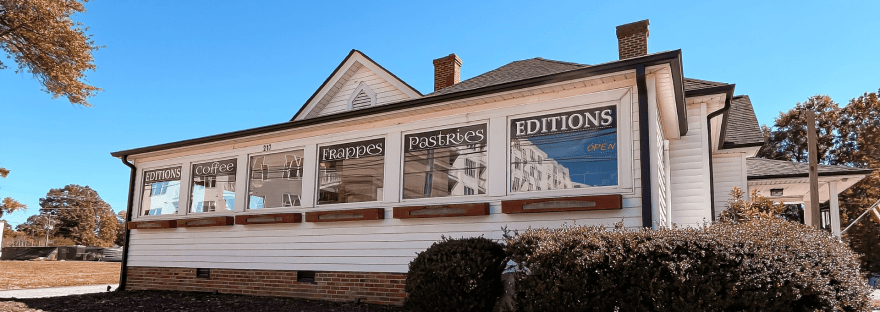
Recently, I came across a thoughtful example from Editions Coffee Shop & Bookstore in Kannapolis, North Carolina, that offers several lessons worth borrowing. When I reached out to learn more, I was struck by how intentionally they’ve designed their book club—not just as a program, but as a relationship-building tool that strengthens community, supports local creators, and drives meaningful engagement. Their social media manager, Amie Detar, was kind enough to share some of their process with me.
Here are a few takeaways that libraries may find especially relevant.
1. Book Clubs as Connection, Not Just Programming
At Editions, book clubs aren’t treated as a standalone event on the calendar. They are framed as a way to deepen connection—between readers, between readers and authors, and between the community and the bookstore itself.
That mindset shift is subtle but powerful. Instead of asking, “How do we host a book club?” they asked, “How do we create space for meaningful literary connection?”
As Detar shared,
“At Editions, we’ve always thought of book clubs as a way to deepen connection: between readers, between readers and authors, and between the store and the broader literary community.”
That philosophy informs every aspect of how their book clubs are structured and facilitated.
Libraries already excel at convening people around shared interests. This example reminds us that the most successful programs often start with intention rather than format.
2. Elevating Local Voices Strengthens the Whole Ecosystem
For their 2025 book club, Editions centered local and independent authors, many of whom joined discussions in person. These weren’t just author talks—they were conversations about craft, publishing journeys, and lived experience.
The impact extended beyond discussion alone.
“We were thrilled to see how engaged readers were, and we even had the opportunity to host New York Times bestselling author Hafsah Faizal alongside several incredible local voices.”
The model also supported authors.
“We also saw a tangible increase in book sales for these authors—many of whom reached new readers through the club—which felt like a true win-win.”
This mirrors what many libraries strive for: supporting local creators while enriching the cultural life of the community. By positioning the library (or bookstore) as a connector, everyone benefits.
3. Engagement Over Scale in Marketing
One of the most interesting takeaways was Editions’ marketing approach. With the exception of one major author event, promotion was entirely organic—driven through social media posts, stories, and collaboration with participating authors.
“Because authors were involved, we collaborated closely with them and were able to tap into their audiences as well as our own.”
Because authors shared events with their own audiences, the reach expanded naturally, and the messaging felt authentic rather than promotional. This is a useful reminder that partner amplification can often outperform paid advertising, especially when trust and relationships already exist.
4. Designing for Participation, Not Performance
Perhaps the most instructive insight came from how Editions is evolving its model for 2026. Based on participant feedback, they plan to shift toward more peer-to-peer discussion—creating space for readers to talk with one another, not just listen to an expert or author.
“We recently surveyed book club members, and the most consistent response was a desire for more peer-to-peer discussion.”
Looking ahead, Detar explained,
“Our upcoming book clubs will emphasize community discussion and flexibility, allowing participants to engage via physical books, ebooks, or audiobooks.”
This mirrors a trend many libraries are seeing: people want dialogue, not lectures. They want room to explore differing perspectives, reflect together, and feel heard. By allowing flexibility in format, Editions is also reducing barriers to participation—another lesson worth noting.
5. An Integrated Approach That Reinforces the Message
While Amie highlighted the role of organic social media in supporting the book club, the overall approach reflects something broader: an integrated marketing ecosystem where multiple touchpoints reinforce one another. ocial media works alongside their email newsletter, website presence, and in-store promotion to create consistent visibility and momentum. Each touchpoint reinforces the others—someone might first hear about a book club online, see it mentioned again in a newsletter, and then encounter it in person while visiting the store.
This layered approach helps ensure that programming isn’t siloed or dependent on one platform’s algorithm. Instead, it meets readers where they already are and reinforces a sense of continuity and community across digital and physical spaces.
For libraries, this is an important reminder: effective marketing rarely hinges on one tool. It’s the coordination across channels—paired with strong relationships and clear purpose—that helps programs feel visible, accessible, and worth showing up for.
6. A Model Libraries Can Adapt
What makes this example so compelling is that none of it requires a massive budget or staff expansion. It relies instead on:
- Intentional program design
- Strong community partnerships
- Authentic storytelling and promotion
- A willingness to listen and evolve
For libraries thinking about how to deepen engagement, strengthen local partnerships, or reimagine book discussions, Editions offers a thoughtful and replicable model.
Sometimes the most valuable inspiration comes not from reinventing the wheel—but from noticing how others are already rolling it forward.

 Cordelia Anderson Consulting